- ManagerShortcuts:
NCC 2025 Update: Waterproofing Over Concrete Substrates
What Are the Key Changes for Waterproofing Concrete Substrates Under NCC 2025?
NCC 2025 Volume One introduces several important waterproofing changes, making it one of the most significant updates to how wet areas in Class 2 to 9 buildings are designed and constructed in Australia.
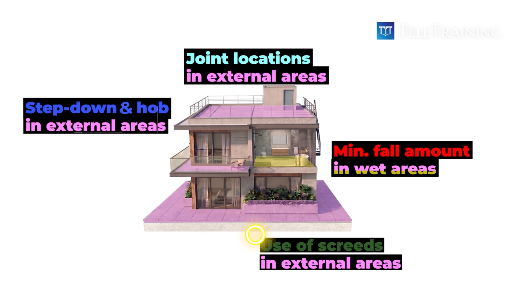
These changes can be grouped into four key categories:
First, use of screeds in external areas
Second, minimum fall requirements in wet areas
Third, step-down and hob requirements in external areas
and last joint locations in external areas
The first change relates to the use of screeds to create falls or as tile bedding in external areas. Historically, topping screeds or tile beds were commonly used on external waterproofed areas to achieve the required falls. Rather than pouring the structural slab to a precise gradient, a screed layer was applied over the slab to form the slope. This was a practical and widely accepted method. However, under NCC 2025, For external areas such as roofs, balconies and podiums, falls must be formed during the concrete pour — not corrected afterwards with a screed.
A topping screed or tile bed can no longer be used to form falls on external waterproofed areas, except in external planter boxes, where it may still be used to achieve the minimum 1:80 fall.
The reason comes down to sub-surface water. When water gets beneath a screed layer — between the screed and the structural slab — it can become trapped. This trapped water can build pressure beneath the membrane, cause delamination, and migrate laterally to areas where water would not normally be expected.
By requiring the membrane to be applied directly to the structural substrate, NCC 2025 helps eliminate this failure pathway.
This principle also affects how tiles are installed in external areas. Screeds no longer can be used as a bedding layer for tiles in external areas and finishes must now be either directly bonded to the membrane or loosely-laid on pedestals. Having said, for internal wet areas, such as bathrooms, a topping screed may still be used to form falls above the structural substrate or as a tile bed, provided the area is waterproofed in accordance with AS 37 40.
The second change relates to the fall amount. Previously, a 1:100 fall was permitted in low-risk areas, such as covered balconies and bathroom areas outside the shower zone. However, NCC 2025 now requires the substrate in internal wet areas, such as bathrooms and laundries, to have a minimum fall of 1:80 and a maximum fall of 1:50.
The 1:50 upper limit helps keep the floor safe and usable underfoot, while the 1:80 minimum helps ensure water drains effectively rather than ponding. For external areas like balconies, podiums and roofs, NCC 2025 sets the minimum fall of the structural substrate at 1:80 as well — so 1:80 is now the baseline across both internal and external concrete areas.
The third change relates to step-down and hob detailing in external areas. Previously, the NCC did not include specific step-down or hob dimension requirements for external areas. Under NCC 2025, a minimum 70 mm step-down is now required from the internal structural substrate to the adjacent external structural substrate.
A minimum 70 mm high monolithic hob, poured integrally with the structural substrate, is also required at the outer perimeter of the external area, unless the area drains directly to a gutter. These details need to be coordinated at the structural design stage, well before the membrane is specified.
The fourth change relates to the location of joints in relation to the ridgeline.
Previous versions of the NCC required exposed joints in a roof, balcony, podium, or similar horizontal surface to be protected. These joints also could not be located beneath, or run through, a planter box.
However, they did not include specific requirements for joint locations in relation to surface falls.
Under NCC 2025, exposed joints in concrete structures must be located at the ridge line of falls — the high point of the surface. This ensures water drains away from the joint rather than passing over it.
This requirement highlights a very critical workflow. Once the joint locations within exposed areas are determined by the structural engineer, the hydraulic engineer must ensure there is a floor drain located on each side of the joint. This allows the architect to detail the substrate falls toward those drains. This highlights the importance of clear communication across all project teams, especially if joint locations change.
Also, where possible, it is good practice to consider detailing hobs along both sides of joints in non-trafficable areas, such as roofs. Note that this is not mandated by NCC 2025, but detailing hobs helps ensure water cannot enter the joint, even if a drain becomes blocked and water begins to pond.
Finally, it is important to note that each state and territory in Australia is adopting NCC 2025 on different dates.
Victoria, Western Australia, Tasmania, and the Australian Capital Territory began adopting the code from 1 May 2026, while New South Wales, Queensland, and South Australia will adopt it from 1 May 2027.